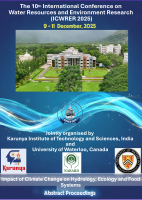
The 10th International Conference on Water Resources and Environment Research (ICWRER 2025)
Keywords:
ICWRER-2025, Water Resources and Environment Research, Climate Change, SDGsSynopsis
A couple of years ago, Prof. Kumaraswamy Ponnambalam of the University of Waterloo enquired with the Water Institute of Karunya Deemed University (KITS) whether the Tenth ICWRER Conference could be hosted by the University in Coimbatore. He also mentioned that the First Conference in 1993, immediately after the Dublin Conference and the Earth Summit, was held at the University of Waterloo in honour of Prof. T. E. Unny, the renowned stochastic hydrologist from India. The event to be held at the Karunya campus from 9-11 December 2025 is the First ICWRER Meet in the country. Water security has become a significant concern for nations worldwide. On its part, the Government of India is committed to achieving the SDGs, and the Ministry of Jal Shakti and other agencies have taken up several initiatives. The growing demand for water due to rapid urbanization and agricultural activities necessitates the sustainable management of water resources. Many areas in the country are under water stress and scarcity. Climate change is feared to exacerbate existing problems, mainly due to increased intensity and frequency of hydrologic extremes, sea-level rise, and snowmelt. Integrated Water Resources Management (IWRM) is a process for sustainable development that allocates and monitors water resource use, considering social, economic, environmental, and institutional objectives. There is a need to assess the efficacy and efficiency of the various techniques and models attempted so far, and also to evolve new ones to address specific and general problems. The case studies on these projects and schemes are expected to throw light on the future course of action to be initiated. Wastewater generation is a multifaceted issue influenced by domestic, industrial, agricultural, and emerging activities. Each source presents unique challenges, necessitating tailored management and treatment strategies to safeguard environmental and public health. By acknowledging and addressing the diverse sources of wastewater, we make significant strides toward a cleaner, healthier, and more sustainable future. Emerging contaminants, viz., microplastics and endocrine disruptors, are increasingly recognized for their potential health impacts and environmental persistence. The aquatic and terrestrial ecosystems are facing threats of different types and dimensions, leading to their degradation and disappearance; the biodiversity of ecosystems, especially aquatic ecosystems, is facing multiple challenges. These are also to be addressed, and experiences shared with a congregation of experts and other stakeholders. The ICWRER-2025 is expected to provide a common platform for experts in water and environment to meet, interact, share their thoughts, and offer their views on future action. Our primary focus has been on students and scholars in the field of water and environment, as well as other stakeholders, who we believe will contribute effectively to future research, academia, policy formulation, and project implementation. The Co-chair and I are thankful to all those from the University of Waterloo and Karunya Institute of Technology and Sciences, and to several experts from different parts of the world who have supported this event, as well as to the delegates – academic and professional - who have shown great interest in this Conference. We now look forward to very fruitful deliberations at the ICWRER-2025, through effective interaction and the contribution of ideas and solutions to address problems faced by the water and environment sectors, finally saving and sustaining our planet and humanity in particular.
Downloads
Published
February 10, 2026
Copyright (c) 2026 E.J. James (Volume editor); Madhumitha, Lydia Pramitha, Dhanusha Balakrishnan, Vidhya Bhojan, P. Jegathambal, J. Dinesh Peter, C. Mayilswami, Sajan Kurien, Poornima Unnikrishnan, Kumaraswamy Ponnambalam, Umesh Chimmalagi (Author)

Details about this monograph
ISBN-13 (15)
978-93-93522-74-0
How to Cite
Kumaraswamy Ponnambalam, Poornima Unnikrishnan, Sajan Kurien, C. Mayilswami, J. Dinesh Peter, P. Jegathambal, Vidhya Bhojan, Dhanusha Balakrishnan, Lydia Pramitha, Madhumitha, Umesh Chimmalagi, & David, S. (2026). The 10th International Conference on Water Resources and Environment Research (ICWRER 2025) (E.J. James , Ed.). IOR INTERNATIONAL PRESS. https://doi.org/10.34256/iorp256